Pipe cladding
Aluminium casing for lagged pipework, cut and formed in our Dublin 12 workshop to the sizes you measure, so every length and fitting closes over the lagging on site.
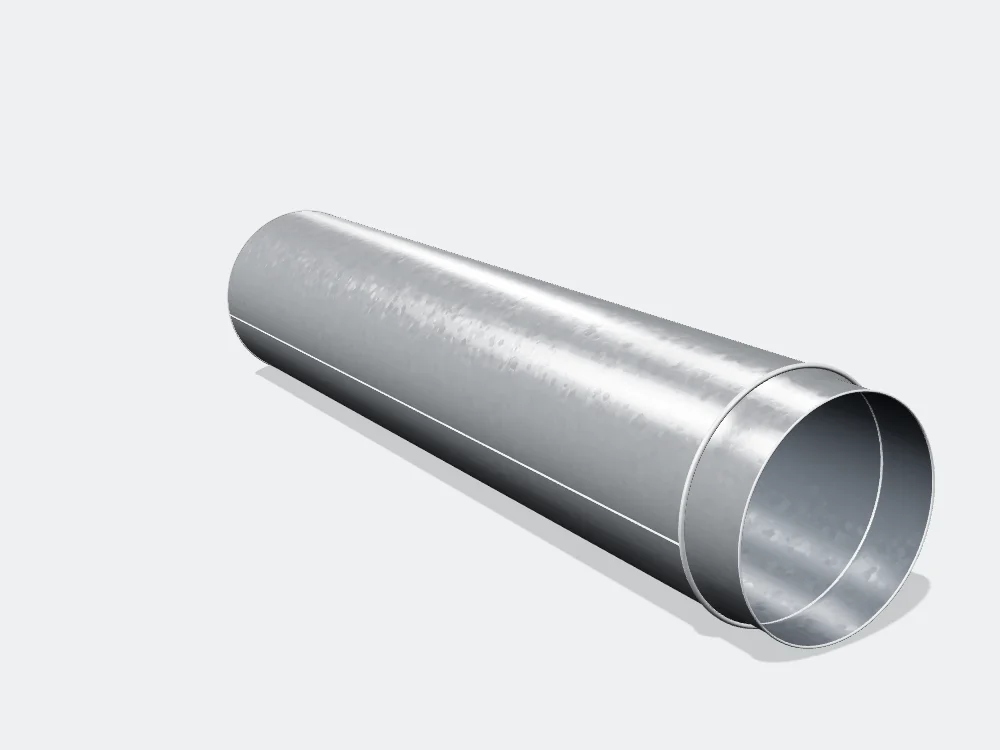
What pipe cladding is
Pipe cladding is the thin metal skin over the lagging on a pipe. It protects the insulation from knocks, weather and water, and gives the job a clean, finished look. You will also hear it called casing or pipe casing; the guide Lagging and jacketing explained covers the other names you will meet on a specification.
Ours is aluminium as standard, 0.6 to 0.8 mm (up to 1.0 mm), plain, stucco embossed or colour-coated, with stainless steel 304 and 316 to order. See aluminium vs stainless steel.
Measuring a pipe
Measure over the lagging, outside to outside, in centimetres. We add a 0.3 cm allowance so the cladding slides on; you do not add it yourself. Never give the bare pipe for a casing, a bend or a tee: a fitting made to the bare pipe will not close over the lagging.
The insulation section is just as good: pipe size × insulation thickness, the way it is written on the box, like 76 × 25 or 168 × 30. We work in these section sizes, not DN sizes. The full method, fitting by fitting, is in how to measure pipe for cladding.
Straight pipe
Straight pipe casing comes in 1 × MTR or 1/2 MTR lengths with swaged ends, a formed step so one length slides into the next, and a short make-up piece finishes a run. Give us the run in metres. On site the upper piece laps over the lower one, watershed lapping, so water runs off, not in.
Bends, elbows and sets
- Radius bend: a smooth turn built as a lobster-back, in short segments, each cut from its own flat pattern. Our standard radius is one and a half times the bare pipe size, to the centre of the pipe, and never tighter than three-quarters of the cladding size. A single bend is never more than 90°; a bigger turn is two bends. The lobster-back vs radius bends guide explains the names.
- Mitred elbow: two pieces, one hard corner, no throat, for tight turns and small pipes.
- Set / offset: a three-piece set that steps the run round an obstruction.
Tees, reducers and end caps
- Tee: equal or reducing branches, cut to sit tight on the main run; the oblique tee takes a branch off at an angle.
- Reducer (in line) steps the cladding down where the pipe changes size; the reducer (flat side) keeps one line of the run level.
- End cap: closes the lagging at the end of a run. Give us the bare pipe that pokes through, because the hole is cut exactly that size, and the insulation size.
Boxes
- D box (valve box): the valve box, with a flat back and a rounded front, in two halves.
- Square box: a removable cover, square or rectangular, in two halves, for anything on a lagged run that still has to be reached.
- Flange box: a round split cover over an insulated flange joint.
Standards, making and delivery
BS 5422 tells the insulator how thick the lagging should be, and the lagging decides the size of the cladding; we make it to fit, working to BS 5422 : 2023. Every pattern is worked out from your measurements, then cut, punched, rolled and swaged in Dublin 12. We aim to quote the same day, and a standard build is about a week from an approved measurement, collected from the workshop or delivered across Ireland. Each fitting page shows the shape and how to measure it, or browse every shape in the pipework fittings list. For ductwork, see duct cladding; for tanks and vessels, tank and vessel cladding.
Next step
Send the sizes, a drawing, a schedule or a photo and we aim to quote the same day. Sending a job is a quote request, not an order. Rather talk it through? Ring or WhatsApp the workshop on +353 87 212 6144, Mon–Fri 07:30–17:00.
Send a job to quoteFor insulation & cladding contractors · All fittings · Guides · FAQ · Contact