Lobster-back vs radius bends
Two names, one fitting. The real choice on site is between a radius bend and a mitred elbow, and then how tight the radius is.
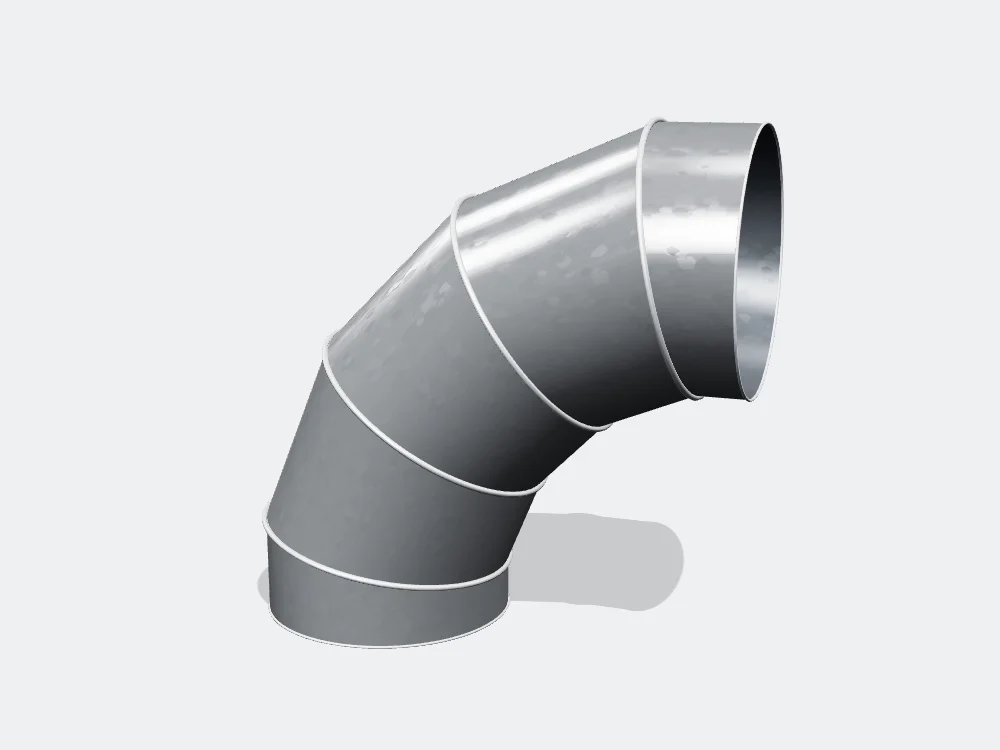
Same bend, two names
In aluminium pipe cladding, a radius bend is built as a lobster-back. The cladding follows the curve of the bend in short segments, with a half-segment at each end, and each segment is cut from its own flat pattern. Laid together, the segments step round the bend like the shell of a lobster’s tail, which is where the name comes from.
So when a drawing says “lobster back” and the order sheet says “radius bend”, they mean the same fitting. On our site it is called the radius bend, the word on our own order sheets.
Segments
More segments give a smoother bend. Five is normal for a 90° bend, and the end segments are half-size as standard. You do not need to count them on site: the calculator fills in the standard, and the workshop sets the segments out when the bend is cut.
The radius: choke, standard or sweeping
Every radius here is a centre radius: from the centre point of the curve to the centre of the pipe, never the inside edge. There are three you will meet:
- Choke: the tight bend, one times the bare pipe size.
- Standard: one and a half times the bare pipe size, never tighter than three-quarters of the cladding size. This is what we make when nothing else is said.
- Sweeping: a long, gentle bend, three times the bare pipe size or more.
The multiples are of the bare pipe, not the size over the lagging, which is why a known insulation section such as 114 × 50 is the easiest way to order a standard bend. If a radius is written on the drawing or measured on site, that number wins.
The one that is different: the mitred elbow
A mitred elbow is not a tight radius bend. It is two pieces meeting on one mitre: a hard corner with no throat and no radius at all. It is ordered by the size and the two legs, each measured from the open end to the outside corner.
On small bore the choice is made for you. A radius bend is made only from 12 cm finished cladding (the size over the lagging plus our 0.3 cm allowance). Smaller than that, we make it as a mitred elbow. Under 8.5 cm finished, even an elbow is too small to make as a standard fitting, and the office prices it on request.
Angles and sets
A single bend is never more than 90°. A bigger turn is two bends, each made and priced on its own. To step a run sideways round an obstruction, use a set: three mitred pieces worked out from the offset and the angle.
Not to be confused with duct bends
Rectangular ductwork has its own bends. Our curved-back bend has flat cheeks and one smooth rolled back, never segmented, and it is sized by its throat. The square bend is a sharp mitred corner, with turning vanes if needed. See duct cladding for the full duct range.
Next step
Send the sizes, a drawing, a schedule or a photo and we aim to quote the same day. Sending a job is a quote request, not an order. Rather talk it through? Ring or WhatsApp the workshop on +353 87 212 6144, Mon–Fri 07:30–17:00.
Send a job to quoteFor insulation & cladding contractors · All guides · How to measure pipe · Trade terms · FAQ · Contact