How to measure tanks and vessels for cladding
A tank is clad in parts: the round body and an end at each end of it. Measure each part over the insulation, and a sketch with the sizes on it is enough for us to start.
The one rule: measure over the insulation
Cladding goes on the outside of the insulation, so every tank size is measured over it. Lay the tape across the widest part of the tank or vessel, outside to outside, over the lagging. It is the same rule as pipe and duct, and it holds whether the tank stands up or lies down.
A tank is never one fitting. The round side is the body, and each end is its own fitting with its own measurements, so a tank with two flat ends needs both ends measured. Send the body and its ends on one job and they are made to match.
The tank body
For the tank body, give us two numbers: the tank size over the insulation, and the height of the body from one end to the other. On an upright tank that is from the bottom of the body straight up to the top; on a tank lying down it is the length of the round side, end to end. We work the body out as one shell to your sizes, then split it into sheets you can lift by hand and fix one after another on site.
Flat ends
A flat tank end is a disc. Give us the diameter of the end over the insulation, and how deep you want the rim: the edge folded down so the end closes neatly over the body cladding. Leave the rim at nought for a plain disc with no turned edge. A flat end suits the top of an upright cylinder, the ends of a horizontal tank, or anywhere a vessel finishes flat.
Domed ends
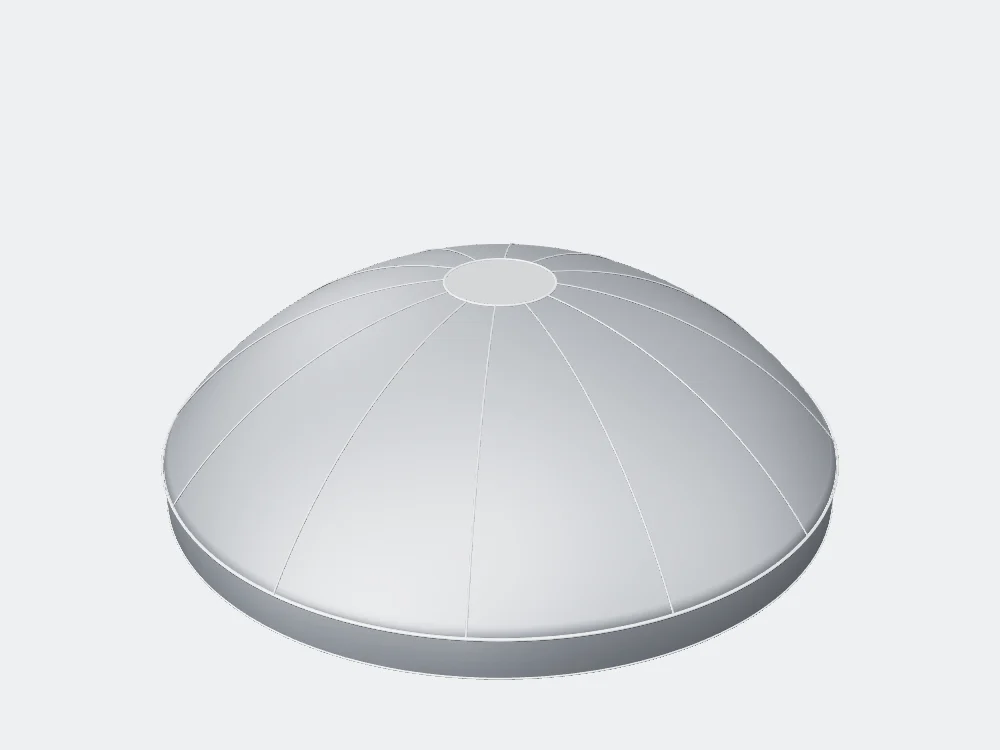
A domed tank end covers a dished head with tapered petals that meet at a small round crown cap. Give us the vessel size over the insulation and the height of the dome, from where it leaves the shell straight up to the very top.
The number of petals and the size of the crown cap are filled in to a standard: 12 petals to start with. More petals give a smoother shape. Change them only if your job needs more or fewer. If a head is not a simple dome, send a photo or the vessel drawing with your sizes and the office will look at it.
Cones
A tank cone takes three numbers: the small size, the large size, and the height of the cone between them, all over the insulation. The same shape does the job of a big reducer, where a large round section steps down to a smaller one. For a step on a lagged pipe run, the in-line reducer is the better fit, because it works from pipe sizes and matches the casing either side.
Round the vessel
- The pipework coming off a vessel is pipe cladding, measured over the lagging: the pipe measuring guide covers it.
- An insulated flange joint takes a flange box, a round split cover: give us the diameter of the box, big enough to clear the flange and its bolts once the insulation is on, and its length, long enough to land on the pipe casing either side.
- Not sure? A sketch of the tank with the body, the ends and their sizes on it is enough for us to start, and we aim to quote the same day. If we got it wrong, we remake it the same week, no charge.
Next step
Send the sizes, a drawing, a schedule or a photo and we aim to quote the same day. Sending a job is a quote request, not an order. Rather talk it through? Ring or WhatsApp the workshop on +353 87 212 6144, Mon–Fri 07:30–17:00.
Send a job to quoteTank and vessel cladding · For pharma & process · All guides · The fitting calculators · FAQ · Contact