D box, square box or flange box
Three lift-off covers for the parts of a lagged run that still have to be reached. Here is what each one is for, and the numbers we need to make it.
Why a box, not fixed cladding
Valves need getting at, and bolted flanges get looked at, tightened and sometimes opened. Casing them in with fixed cladding means cutting it off every time. A removable box comes in two halves: it comes off for maintenance and goes back on tight, so the insulation underneath stays covered.
Which box?
- A valve: the D box (valve box).
- A round cover over a flange joint: the flange box.
- A square or rectangular cover: the square box. We use square boxes for all sorts of jobs, wherever something on a lagged run needs covering but still has to be reached.
The D box (valve box)
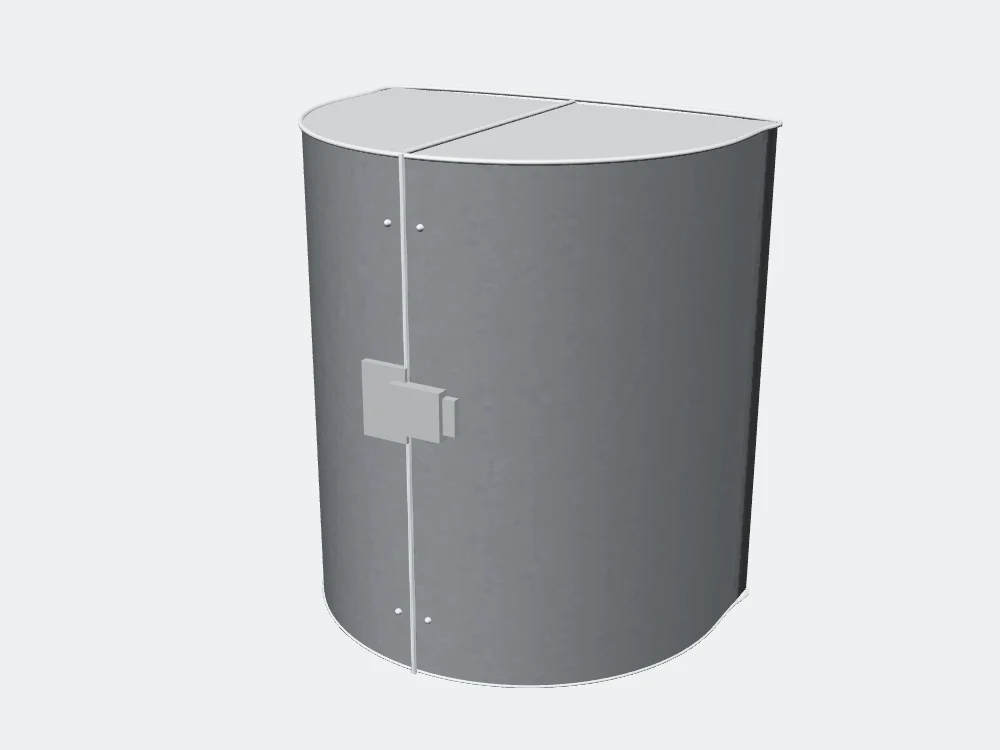
A D box is our valve box. It has a flat back and a rounded front, like the letter D, and it lifts off when someone needs to get at the valve.
It is made from its own length, width and depth: no pipe size is needed. The length runs along the pipe, long enough to cover the valve body. The width is across the flat back, wide enough to cover the valve, plus about 2.5 cm working room each side. The depth is from the flat back out to the front of the curve. The handle is left outside the box. Several valves on one run? Give each box its own sizes, because valves on one run are not always the same.
The square box
A square box is a removable cover, square or rectangular, made in two halves. Give us the width, the depth and the length of the box. The width is across the front, the full width of whatever it covers, plus about 2.5 cm working room each side; the depth is how far it must stand off to clear what it covers, plus a little room.
If a pipe runs through it, add the pipe size over the lagging, and the ends are notched to fit round it. Leave the pipe size blank and the box gets solid end plates instead. A photo of what the box has to cover, with a tape in it, helps us get it right first time.
The flange box
A flange box is a round split cover: two halves of a rolled body with solid end plates, so it can come off for the joint to be checked and then go back on. It is made from two numbers: the diameter of the box and its length. Make the diameter big enough to clear the flange and its bolts once the insulation is on, and the length long enough to land on the pipe casing either side. Several flanges on one run? Give us each size, as they are not always the same.
Fastening, metal and making
The halves close with quick-release toggle latches or with rivets, and a D box can have a wire-hinged back too: say which you want when you send the job. Boxes are made in aluminium from 0.6 to 1.0 mm, plain or stucco, every one to your measurements in our Dublin 12 workshop, typically in about a week from an approved measurement, and we aim to quote the same day. The pipe measuring guide covers the casing either side of a box.
Next step
Send the sizes, a drawing, a schedule or a photo and we aim to quote the same day. Sending a job is a quote request, not an order. Rather talk it through? Ring or WhatsApp the workshop on +353 87 212 6144, Mon–Fri 07:30–17:00.
Send a job to quotePipe cladding · For insulation & cladding contractors · All guides · The fitting calculators · FAQ · Contact